DirtyThird
About Archive Photos Replies Also on Micro.blog
  • Slide Towards the Mean: Predators 4 - Blackhawks 3

    Slide Towards the Mean: Predators 4 - Blackhawks 3

    Note: Normally, I won’t do these on weekends, but I’ve been having fun with micro.blog, so here you go.

    The Chicago Blackhawks' 4-3 loss to the Nashville Predators extended their losing streak to five games. Of the five teams the Hawks lost to, three of them were teams the Hawks should have beaten. But didn’t. Except for the Buffalo game (a team they should have beat), all of their losses have been by one goal. Two of those were against the Colorado Avalanche and the Minnesota Wild. Last night’s game? Winnable but ugly.
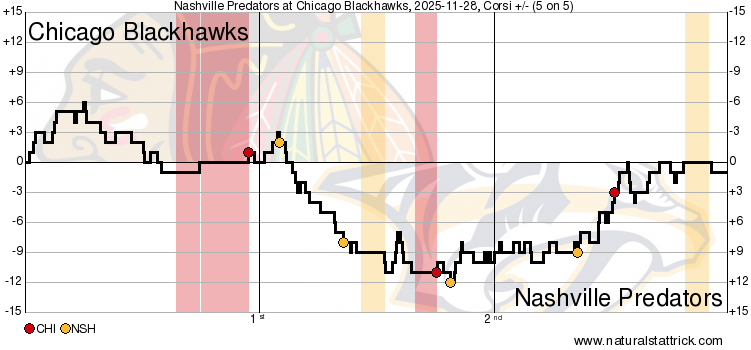
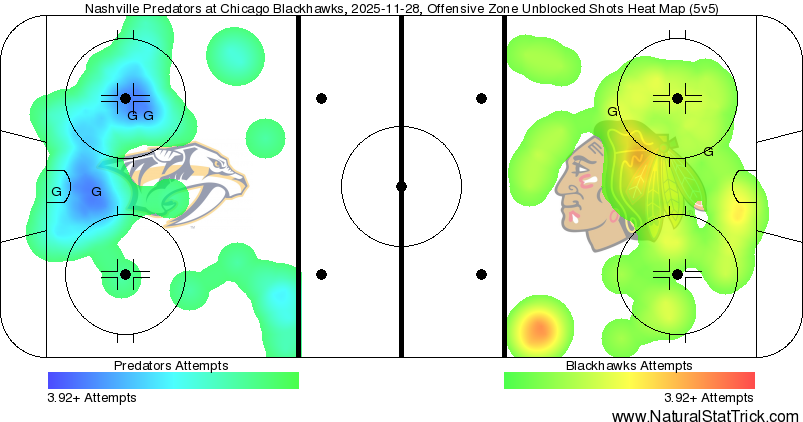
    Auto-generated description: A line graph displays the Corsi differential over time for a game between the Chicago Blackhawks and Nashville Predators, highlighting shifts in momentum during the match. Auto-generated description: A heat map displays the offensive zone unblocked shot attempts by the Nashville Predators and the Chicago Blackhawks during a game, with concentrated areas indicated by varying colors on the rink diagram.

    Game Notes

    Chicago started the game strong, especially from the second line (Bertuzzi-Nazar-Teravainen). That line had a strong first shift with good wall play. But the first was fairly even for both Chicago and Nashville. 5v5 shot attempts were split evenly with a 50% Corsi, but the Hawks had a 43.71% expected goals share. A bit more annoying was that the Hawks had six minutes of the man-advantage towards the end, but didn’t score (Ryan Donato did score the opening goal after the power play ended).

    The second period is where the Hawks' warts really began to show. Chicago had a 38.1% Corsi and a 32.16 xG% at 5v5, and the eye test reflected that. The Hawks' defense struggled to break out, made bad passes, and didn’t play solid defense. The Predators took advantage of the Hawks' poor neutral zone play by leaving a winger up high for the stretch pass. That’s how Matthew Wood scored Nashville’s first goal and how Ryan O’Reilly scored in the third period. By the way, I recall the Preds taking advantage of the Hawks like this last season. Below is a shot map from the second period.
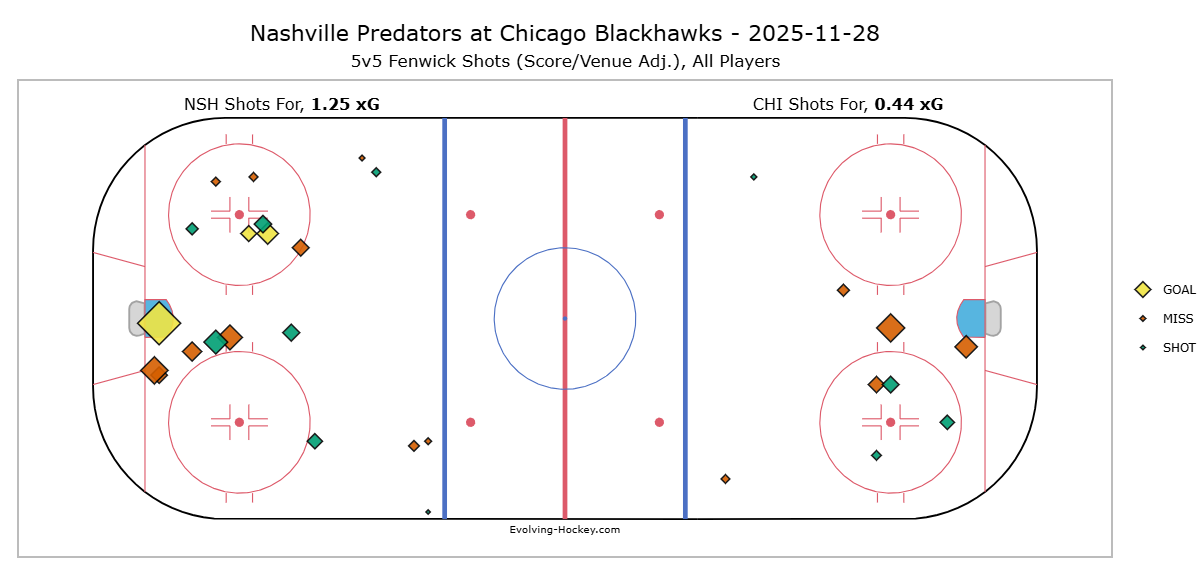
    Auto-generated description: A hockey rink diagram shows the shot attempts by Nashville Predators and Chicago Blackhawks during a game, with various symbols indicating goals, misses, or blocked shots.

    Steven Stamkos scored the second goal for the Preds following a Frank Nazar turnover in the NZ. This came after prolonged time in the Hawks' zone, but really highlighted the type of night the Hawks had in the DZ and NZ.

    Yes, the game wasn’t only on the Hawks' defense (Oliver Moore made some errors that stood out to me), but if the defense had been tighter, Nashville wouldn’t have scored four goals. Sure, Luke Evangelista’s goal should have been stopped by Arvid Soderblom, but I’m not pinning this loss on him by any means.

    Bonus Observations

    • Connor Bedard only had three shots on goal and three shot attempts at 5v5.
    • Ryan Greene had three shots on goal and seven shot attempts. I’ve said it in the past, I think Greene will be an excellent third-line player. Whether that’s on the wing or the middle.
    • Frank Nazar continued to look not himself. He had two shots on goal and two shot attempts. The Hawks had a 44.44% Corsi and 31.93 xG% (5v5) with him on the ice.
    • I would have liked to see the Hawks put a bad second period behind them and open the third ready to kill a one-goal deficit. Unfortunately, that push never came until Teuvo Teravainen scored on a Juuse Saros mistake.
    • Final thought… on the Blackhawks' jerseys. I know some people don’t like them, but I thought they looked great. I don’t care that every team has a black alternate (and sure, not every team needs one), but the Hawks have had black jerseys going all the way back to 1926.
    → 10:43 AM, Nov 29
    Also on Bluesky
  • Arty Party

    Arty Party

    Bear with me. I’m still learning the quirks of micro.blog, but so far… I really like it. Figured that while I’m in a turkey-induced coma, I’d give a Blackhawks post a shot. I have this scheduled to post in the morning, so we’ll see how that goes. Also, the Hawks play tonight at 7 pm CT; they’re hosting the Nashville Predators.

    Let’s talk about Artyom Levshunov.

    A quick note, apologize for any weird formatting or glitches. Still learning how to do this in Markdown


    Levshunov

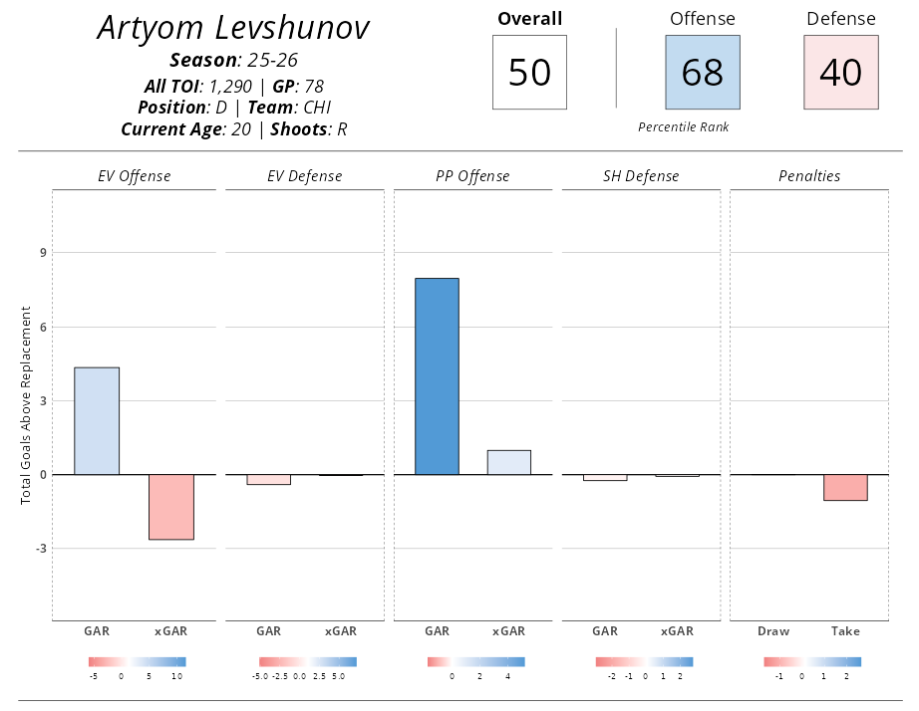
    Auto-generated description: Hockey player Artyom Levshunov's performance chart shows offensive and defensive metrics, highlighting strengths in power play offense and weaknesses in penalties.

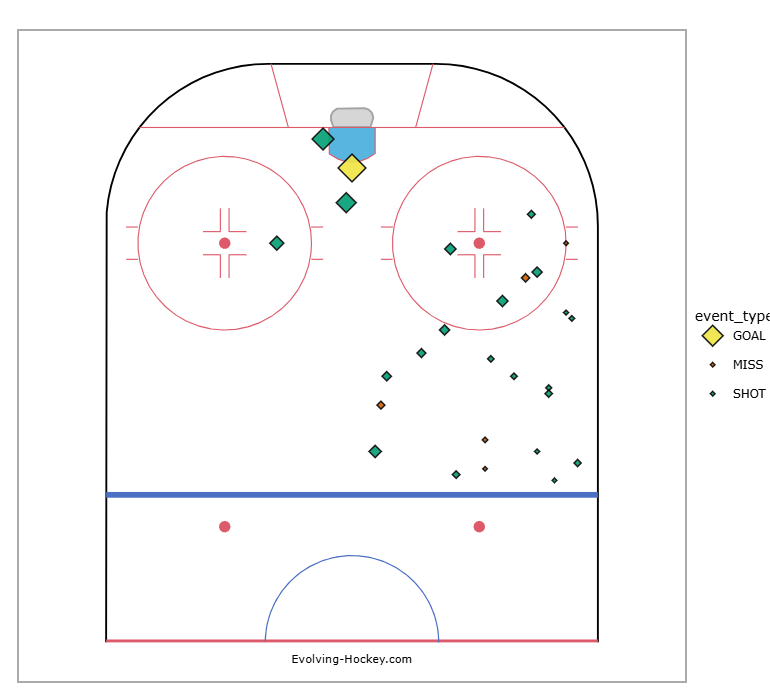
    Artyom Levshunov finally scored his first NHL goal in the Blackhawks' 4-3 OT loss to the Minnesota Wild on Wednesday night. Surprisingly, it took 40 games in the NHL—he’s been at a 4.31 shots per 60 and 8.79 shot attempts/60 this season alone. That’s a high volume of shots, and some might look at that as “garbage” volume. A high volume of low-quality shots doesn’t really mean much. I’d argue that if it’s coming from a defenseman on the point, that’s a good thing because those are the shots that turn into rebounds.

    Auto-generated description: A hockey rink diagram displays various marked points indicating the locations of goals, misses, and shots.

    Levshunov’s high-volume shooting was one of the arguments a friend used to point out why Levshunov wasn’t a good player. The other arguments were a large amount of starts in the offensive zone, terrible decision-making, and horrible defensive zone mistakes. This friend was also very upset that Ivan Demidov wasn’t selected in 2024 (I don’t blame him; most of us were).

    Let’s look at some numbers. 71% of Levshunov’s shifts start in the offensive zone (OZ), according to Natural StatTrick. That’s the highest on the team. There’s certainly a lot of sheltering there, but considering that Levshunov is 19, should arguably be with the Rockford IceHogs (something I disagree with), and has an offensive tool set—I’m fine with that. But those zone starts are partially why his stats look pretty good (a 49.09 xG% but a 56.13% actual goals share at 5v5).

    This clip is a perfect example of what Levshunov usually does after making a bad decision. He’s such a good skater that he backchecked and recovered to disrupt a Seattle Kraken breakaway. The mistake that led to this (an ill-timed pinch) is an example of the types of reads that Levshunov usually finds himself cleaning up (like that giveaway when he was QBing the PP1). But he finds a way to come back from those mistakes.

    Like most young defensemen, Levshunov has a long way to go in the DZ. But I don’t think he’s been that bad. His reach often breaks up plays, and he’s physical on the puck carrier. Concerns include puck watching, going behind the net when he shouldn’t, and what he does with the puck on a retrieval. But like most young defensemen, the defense will come. I’m more concerned with what he does when the Hawks are trying to score, anyway.

    As of tonight, Artyom Levshunov is tied for fourth in scoring with 14 points. He has questionable decision-making and needs to clean up some defensive zone work. But Levshunov has been very impressive considering his age. Should he be in the AHL? That’s up for debate, but because of his skating ability, I still believe keeping him in the NHL is fine. Should we have taken Ivan Demidov? As someone who watches a lot of Montreal Canadiens games, I still think that’s a sore subject for me. Either way, Levshunov’s chaotic play has made me second-guess my take that he should be in the NHL, but right now, the kid belongs.

    → 6:00 AM, Nov 28
    Also on Bluesky
  • RSS
  • JSON Feed